
IIf you’re applying to study in Canada this year, getting your paperwork right the first time matters more than almost anything else in the process. The documents required for Canada study visa applications form the single biggest reason genuine, eligible students get refused — not because they weren’t qualified, but because one form was missing or one certificate wasn’t attested correctly. IRCC (Immigration, Refugees and Citizenship Canada) doesn’t give you a second chance to fix an incomplete file — it simply comes back marked incomplete, and you lose weeks.
This guide walks through every one of the documents required for Canada study visa approval in 2026, in the order IRCC expects to see them.
Full List: Documents Required for Canada Study Visa (2026)
Before we get into detail, here are all the documents required for Canada study visa applications, at a glance:
- Valid passport
- Letter of Acceptance (LOA) from a Designated Learning Institution (DLI)
- Provincial or Territorial Attestation Letter (PAL/TAL) — where applicable
- Proof of financial support
- Academic transcripts and certificates
- Language proficiency proof (IELTS/PTE/TOEFL)
- Passport-size photographs (IRCC specification)
- Medical examination report (where required)
- Police clearance certificate (case-by-case)
- Statement of Purpose / Letter of Explanation
- Biometrics
- Certified translations for any non-English/French documents
- Additional documents for special cases (minors, Quebec, dependents)
Let’s break down each of the documents required for Canada study visa applications one by one.
Documents Required for Canada Study Visa #1: Valid Passport
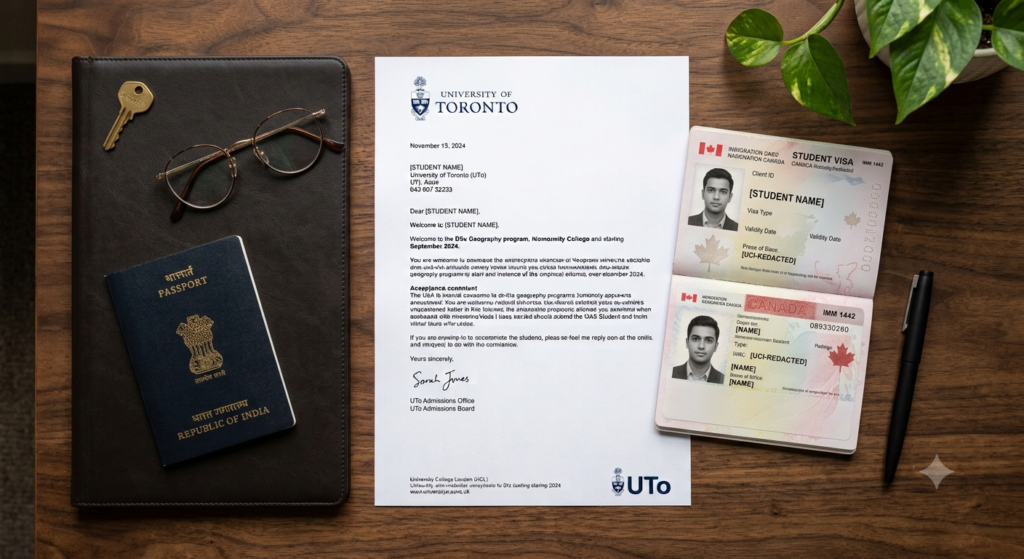
Your passport is the foundation of the entire application, and it’s the first of the documents required for Canada study visa approval. It must remain valid for your entire intended period of study in Canada, including any program extensions, co-op placements, or practicum terms. If your program runs from September 2026 through 2029, for instance, your passport needs to cover that full window with a safety buffer. Renew before applying if it falls short — a passport expiring mid-program is a common, entirely avoidable reason for delay.
Documents Required for Canada Study Visa #2: Letter of Acceptance (LOA)
You must be accepted by a Designated Learning Institution (DLI) — not every Canadian school qualifies, so confirm your institution’s DLI number before paying any deposit. The LOA must clearly state your program, start date, and DLI number, and this number needs to match what you enter on your application. A mismatch here is one of the more common paperwork errors that trigger a request for clarification mid-processing.
Documents Required for Canada Study Visa #3: PAL/TAL
This is one of the newer additions to the list of documents required for Canada study visa applications, and it trips up a lot of applicants who researched requirements from a couple of years ago. Since 2025, most undergraduate, college, postgraduate diploma, and private-college language-program applicants need a Provincial Attestation Letter (PAL) or Territorial Attestation Letter (TAL) issued by the province or territory where they’ll study, confirming they have a spot under that province’s intake cap.
The one meaningful update for 2026: as of January 1, 2026, master’s and doctoral students enrolled at a public DLI are exempt from this requirement. Students extending a permit at the same DLI, and elementary/secondary students in some provinces, are generally exempt too — though this varies, so confirm with your institution. Your DLI’s international office typically manages the PAL request on your behalf once you’ve paid your deposit.
Documents Required for Canada Study Visa #4: Proof of Financial Support
This is where most applications succeed or fail, and it’s often the trickiest of all the documents required for Canada study visa approval. IRCC needs to see that you can cover tuition, living expenses, and return travel for at least one year. As of the current threshold in effect since September 2025, a single applicant outside Quebec needs to show close to CAD $22,895 in living-expense funds, on top of your first year’s tuition.
Acceptable proof includes:
- Bank statements or passbook covering the last four months
- A Guaranteed Investment Certificate (GIC) from a participating Canadian bank
- A letter of financial support from a parent or sponsor, along with their financial documents
- Scholarship or funding award letters
- Proof of education loan sanction
One important 2026 update: the old Student Direct Stream (SDS), which allowed a faster GIC-based route for select countries, was discontinued in late 2024. Every applicant — regardless of nationality — now goes through the regular stream and is assessed against the same full set of documents required for Canada study visa approval. A GIC is still accepted as one form of proof, but it’s optional rather than a fast-track requirement.
Academic Transcripts and Certificates
Include transcripts and certificates from your last completed level of education, along with any prerequisite qualifications your specific program requires. If you’re applying straight after Class 12, that means your board mark sheets; for postgraduate programs, your full undergraduate transcript. Keep both originals and attested copies ready — some visa offices request notarized copies alongside the standard set.
Language Proficiency Proof
Unlike most other requirements on this list, your language test isn’t set by IRCC directly — it’s set by your institution. Most Canadian DLIs require IELTS, PTE Academic, or TOEFL scores meeting a minimum band, and this score requirement varies by program and university. Confirm the exact requirement with your DLI before booking your test, since a re-test due to a wrong assumption can cost you weeks.
Passport-Size Photographs
IRCC has strict photo specifications — size, background color, and even how recently the photo was taken all matter. Photos that don’t meet spec are a small but entirely preventable reason for processing delays. Most photo studios near visa application centres are familiar with the exact IRCC format if you’re unsure.
Medical Examination
A medical exam is required for most applicants planning to stay six months or longer, and for applicants from certain countries regardless of program length. This typically costs between CAD $200 and $400 depending on where you take it, and must be done through an IRCC-approved panel physician. Book this early — appointment slots at panel physician clinics can get backed up during peak intake seasons.
Police Clearance Certificate
Not always mandatory upfront, but IRCC can request this case-by-case during processing. It’s worth preparing your PCC in advance if you suspect you might need one, since document delays waiting on a police clearance can add weeks to an otherwise complete file.
Statement of Purpose
This is your chance to address anything an officer might question — gaps in education, choice of program, or ties back home. A strong Letter of Explanation clearly outlines your academic intent, why this specific program and institution, and your plan to return home after your studies, backed by real ties like family, property, or a job offer to come back to. Generic, copy-paste SOPs are one of the easiest things for an experienced officer to spot.
Biometrics
Most applicants need to give biometrics — fingerprints and a photo — in person at a visa application centre. This costs CAD $85 and remains valid for 10 years, so if you’ve given biometrics for a previous Canadian visa within the last decade, you likely won’t need to repeat this step.
Certified Translations
Any document not already in English or French needs a certified translation, submitted alongside the original. This applies to transcripts, bank statements, and any supporting letters in a regional language. Don’t submit machine-translated documents — IRCC expects a certified translator’s declaration of accuracy.
Special Cases: Quebec, Minors, and Dependents
- Quebec-bound students need a Certificat d’acceptation du Québec (CAQ) from the Quebec Ministry of Immigration before their IRCC application can even proceed. Start this process as early as possible, since it has its own separate timeline.
- Minors travelling without a parent need a notarized custodian declaration (Form IMM 5646), signed by both the parent abroad and the Canada-based custodian.
- Applicants bringing a spouse or children need to include marriage and birth certificates, plus documentation linking the family members to the principal applicant’s DLI enrollment.
Processing Times and Fees to Budget For
The standard study permit application fee is CAD $150, plus CAD $85 for biometrics if required. For applicants from India, current 2026 processing times run roughly 8 to 14 weeks, depending on how complete the file is and the time of year you apply. Applying between May and July for a September intake typically adds 2–4 weeks to this, since visa offices see the heaviest volume during that window — applying early is one of the simplest ways to avoid delays that have nothing to do with your eligibility.
Final Checklist: Documents Required for Canada Study Visa
- Passport valid through your entire program (plus buffer)
- LOA with correct, verified DLI number
- PAL/TAL obtained (if your category requires one)
- Proof of funds covering tuition + ~CAD $22,895 living costs
- Transcripts and certificates, attested where needed
- Language test score meeting your DLI’s requirement
- IRCC-spec passport photographs
- Medical exam completed through an approved panel physician (if required)
- Police clearance certificate ready, in case requested
- Genuine, specific Statement of Purpose
- Certified translations for any non-English/French documents
- CAQ, custodian declaration, or dependent documents, if applicable
Getting every one of these documents required for Canada study visa approval right on the first submission is what separates a smooth 8-week approval from a file stuck in limbo for months. If you’d rather have an experienced set of eyes go through your documents before you submit, our study visa consultants at Focus Overseas can review your full file and flag anything IRCC is likely to question — before it becomes a refusal.
For the most current and authoritative list of documents required for Canada study visa applications, always cross-check against the official IRCC study permit page, since financial thresholds and PAL rules are updated periodically.